1. Introduction
Now a days music is mostly used to encourage or blaster movement, and progressively utilize as rehabilitation movement. Thire is some confirmation that music symbolism reported to lead ligaturing of the brain like recognition of music, can really assis development
| [51] | Thaut, M. H., Kenyon, G. P., Hurt, C. P., McIntosh, G. C., and Hoemberg, V. (2002). Kinematic optimization of patio temporal patterns in paretic arm training with stroke patients. Neuropsychology. |
| [8] | Bood, R. J., Nijssen, M., van der Kamp, J., and Roerdink, M. (2013). The power of auditory-motor synchronization in sports: enhancing running performance by coupling cadence with the right beats. |
[51, 8]
(Thaut, et al., 2002; Bood et al., 2013). Also it isn’t yet known musical cues or envisioned enhance the way of activating human brain during basic movement. Than functional magnetic resonance imaging (FMRI) was used for comparing neural performance. Focusing specially on human moter network of the brain, test or experiment wer perform inside the basal ganglia the entire cerebellum and the motor nuclei of the thalamus, results demonstrate that self-space movement in contrast with music specially increases activities in left part of the cerebellum. Activation in pre-supplementary area is mostly caused by imagined music. At the point when music and symbolism signaling condition were directly compare results shows right, left hemisphere and base of cerebellum is more active. But Pre-SMA is more active in imaginary condition
| [47] | Schaal, S., Sternad, D., Osu, R., and Kawato, M. (2004). Rhythmic arm movement is not discrete. Nat. Neurosci. |
[47]
(Schaal et al., 2004).
Activating by music cerebellum could be same to that when touching to imagined music, as compare to self-space movement. Specially it is reported that bilateral striatum to be more dynamic for (non-musical) sound related than for recognition, demonstrating that activity in that area could be increases for cueing i.e. imaginings based
| [15] | Daselaar, S. M., Porat, Y., Huijbers, W., and Pennartz, C. M. A. (2010). Modality- specific and modality-independent components of the human imagery system. |
[15]
(Daselaar et al., 2010). Testing the with motion capture of the movement predicted that such as wrist flexion for simple movement in term of global movement parameter differences between conditions such as rang of movement and speed. By testing criteria in simple term auditory ability and hand references, two method were used, the recruitment standards in terms of over-all aural imagery skill and hand preference, the auditory part of the (SBQUMI)
| [48] | Sheehan, P. W. (1967). A shortened form of Betts’ questionnaire upon mental imagery. J. Clin. Psychol. |
[48]
(Sheehan, 1967) and the EHI
| [40] | Oldfield, R. C. (1971). The assessment and analysis of handedness: the Edinburgh inventory. Neuropsychologia. |
[40]
(Oldfield, 1971) the perceptional criteria in according of simple music imagery specificities and hand preference, the auditory part of the (SBQUMI)
| [48] | Sheehan, P. W. (1967). A shortened form of Betts’ questionnaire upon mental imagery. J. Clin. Psychol. |
[48]
(Sheehan, 1967) and the EHI
| [40] | Oldfield, R. C. (1971). The assessment and analysis of handedness: the Edinburgh inventory. Neuropsychologia. |
[40]
(Oldfield, 1971). In a questionnaire the experimenter were told to level the precision and easiness of the assignment on a scale having five-point, also give detail previous musical exercise knowledge, and also predict how and when they imagine generally the music.
Current study shows that, Activity of the brain in the cerebellum during a wrist flexion movement activity was exactly according to how that situation was pained. It is found to be differential reactions in Pre-SMA, cerebellum and Globus pallidus. According to a research either wrist flexion perfumed to imagined melody, to melody or were self-spaced. Additional activity were not shown significantly by self-spaced to both of the condition that was designed. A general behavioral investigation showed that these neural differences were not identified with net contrasts in performance. The number, sufficiency, and speed of the movement demonstrated no huge contrasts among circumstances. Consequently, in the shown circumstances, expanded activation in particular motor zones were related with a comparable behavioral yield, recommending varying neural procedures to prompt to a similar movement. My information give an immediate correlation of musically signaled and un-cued movement while retaining movement intricacy minimal, and both join and separate from earlier results. As anticipated, we watched pre-SMA enactment amid development prompted by melodic symbolism with respect to heard music and in addition in respect to self-managed movement. Considered every things, the theorized action increment in foremost cerebellum and action diminishment in PMC for musically signaled contrasted and self-managed movement was not observed. The regions that was activated in the prompted circumstances over the self-spaced condition (left cerebellum for music, and right palladium and right (pre-SMA) for music symbolism) are all areas that have beforehand been ensnared in finger tapping tasks prompted by sound-related pacing signals yet have not been found in coordinate examinations of cued to un-cued movement.
1.1. Brain
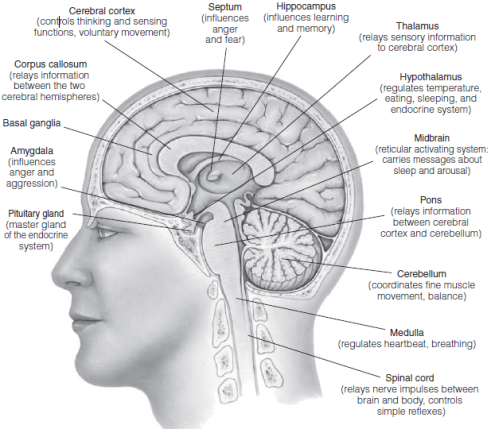
The human brain is consist of three major regions or parts: forebrain, midbrain, and hindbrain. These in an adult or even a child’s head labels do not correspond exact locations of these regions. But, we take these terms from the location of physical arrangement i.e. front-to-back of these parts in the nervous system of a developing embryo
| [35] | Kraemer, D. J. M. Macrae, C. N. Green, A. E. and Kelley, W. M. (2005). Sound of silence activates auditory cortex. Nature. |
[35]
(Kraemer et al., 2005). Auditory cortex be activate by silent sound. Nature. Generally, the forebrain is the frontal, toward face what we looking at. The midbrain is next part in line of brain. Finally the hindbrain comes that is generally very fare from the forebrain, and located near the back of the neck.
1.2. Forebrain
Forebrain is located toward the front and top of the human brain. It is consist of the cerebral cortex, the limbic system, the thalamus, the hypothalamus and the basal ganglia
| [45] | Rockland, K. S. (2000). Brain. In A. E. Kazdin (Ed.), Encyclopedia of psychology. Washington, DC: American Psychological Association. |
| [36] | Lerner, A. J., & Riley, D. (2008). Neuropsychiatric aspects of dementias associated with motor dysfunction. In S. C. Yudofsky & R. E. Hales (Eds.), The American Psychiatric Publishing textbook of neuropsychiatry and behavioral neurosciences. |
[45, 36]
(Rockland, 2000; Lerner & Riley, 2008). The outer layer of cerebral hemisphere is called cerebral cortex. In thinking and other mental processes it plays an essential role.
1.3. The Basal Ganglia
Singular: ganglion, are the collections of neurons essential to motor functioning. Motor deficits occurs as a result of the dis-functioning of the basal ganglia
| [38] | Malsbury, C. W. (2003). Hypothalamus. In L. Nadel (Ed.), Encyclopedia of cognitive science. London: Nature Publishing Group. |
[38]
(Malsbury, 2003).
1.4. The Limbic System
It is the main region of our brain which help us to change our behaviors suitable in reaction to our changing environment. It is also important in learning, memory, motivation and emotion activation.
| [37] | Lewis, S. J. G., & Barker, R. A. (2009). A pathophysiological model of freezing of gait in Parkinson’s disease. Parkinsonism and Related Disorders. |
[37]
(Lewis & Barker, 2009).
1.5. The Hippocampus
Plays a vital role in memory formation. Its name comes from a Greek word for “seahorse,” due to its approximate shape
| [37] | Lewis, S. J. G., & Barker, R. A. (2009). A pathophysiological model of freezing of gait in Parkinson’s disease. Parkinsonism and Related Disorders. |
[37]
(Lewis & Barker, 2009). The hippocampus is important for spatial memory, relations among items learned as well as for flexible learning.
1.6. The Thalamus
Analyses incoming basic information through cluster of neurons that directed it to the proper region of the cortex in the brain
| [38] | Malsbury, C. W. (2003). Hypothalamus. In L. Nadel (Ed.), Encyclopedia of cognitive science. London: Nature Publishing Group. |
[38]
(Malsbury, 2003).
It is regularly interacts with the limbic system of the brain. The hypothalamus is specially involve in behavior related to species survival i.e. fighting, mating, feeding and fleeing. The hypothalamus specially activate in emotional situation and reactions to stress
| [38] | Malsbury, C. W. (2003). Hypothalamus. In L. Nadel (Ed.), Encyclopedia of cognitive science. London: Nature Publishing Group. |
[38]
(Malsbury, 2003).
1.7. Midbrain
It helps in controlling movement of the eye and coordination. It is main source of controling of auditory and visual information therefore it is more important in non-mammals. But forebrain is responsible for these functions in mammals.
1.8. Hindbrain
This part of the brain consist of, the pons, the cerebellum and medulla oblongata
| [38] | Malsbury, C. W. (2003). Hypothalamus. In L. Nadel (Ed.), Encyclopedia of cognitive science. London: Nature Publishing Group. |
[38]
(Malsbury, 2003).
1.9. The Medulla Oblongata
Controls activity of the heart and specially controls, swallowing, digestion and breathing
| [37] | Lewis, S. J. G., & Barker, R. A. (2009). A pathophysiological model of freezing of gait in Parkinson’s disease. Parkinsonism and Related Disorders. |
[37]
(Lewis & Barker, 2009). It is the place where the nerves from the left side of the brain cross nerves coming from the right of the body and nerves of the right of the brain cross over nerves coming from the left side of the body
| [36] | Lerner, A. J., & Riley, D. (2008). Neuropsychiatric aspects of dementias associated with motor dysfunction. In S. C. Yudofsky & R. E. Hales (Eds.), The American Psychiatric Publishing textbook of neuropsychiatry and behavioral neurosciences. |
[36]
(Lerner & Riley, 2008).
1.10. The Pons
serves as a bridge or relay station that transmitted signals from one part of the human brain to another because it contains neural fibers
| [38] | Malsbury, C. W. (2003). Hypothalamus. In L. Nadel (Ed.), Encyclopedia of cognitive science. London: Nature Publishing Group. |
[38]
(Malsbury, 2003).
1.11. The Cerebellum
comes from a Latin word means “little brain”. It controls muscle tone, body balancing and bodily coordination,
| [37] | Lewis, S. J. G., & Barker, R. A. (2009). A pathophysiological model of freezing of gait in Parkinson’s disease. Parkinsonism and Related Disorders. |
[37]
(Lewis & Barker, 2009), to some aspects it is also involve in procedure-related to memory movements.
Figure 1. Structures of the Brain. The forebrain, the midbrain, and the hindbrain contain structures that perform essential functions for survival and for high-level thinking and feeling.
1.12. Regions Related to Music of the Human Brain
Music researchers have used brain-mapping techniques in an attempt to explore the role of music in brain activation. Early studies that attempted to confine music to one hemisphere of the brain led to current research that indicates music’s ability to bridge the hemispheres. More importantly than determining specific regions of the brain, that process music is the understanding of musical study’s effect on neural pathways. Based on the concept of brain plasticity, research shows that the brain changes through the musical experiences. Numerous studies show the various changes seen in musician’s brains
| [7] | Blood, A. J., & Zatorre, R. J. (2001). Intensely pleasurable responses to music correlate with activity in brain regions implicated in reward and emotion. Proceedings of the National Academy of Sciences of the United States of America. |
| [41] | Olson, C. A. (2010). Music training causes changes in the brain. Teaching Music. |
[7, 41]
(Blood & Zatorre, 2001; Olson, 2010). Dermis, left hemisphere and right hemisphere of the Cerebellum showed relatively more activity during musical condition
| [20] | Gaser, C., & Schlaug, G. (2003). Brain structures differ between musicians and non-musicians. Journal of Neuroscience. |
[20]
(Gaser, & Schlaug, 2003).
Hodges (2000)
| [25] | Hodges, D. A. (2000). Implications of music and brain research. Music Educators Journal. |
[25]
notes that as neuroscientists study the effect of musical training, they are now “able to find things about the brain that they didn’t know through other cognitive activities”. Through music it is possible now that we can find, share, express, and think about parts of the human experience". Hodges identified five fundamental premises from different neuro-musical thinks about:
A. Human mind has the potential to participate and respond to liked music.
B. Human brain works during childbirth and continued throughout life.
C. Musical brain organization can be effected by early and ongoing musical training.
D. The musical regions brain largely compose of and widely distributed neural systems involving, but locally specialized.
E. The musical brain is highly resilient.
Each of the above represents an understanding of the brain’s function in regards to musical responses. In studying specific regions of the brain, Hodges identified each one’s relation to music: cognition, effectiveness, and motor. In all areas, there is evidence of change in perception (physiological changes) in the human brain by exposing it to various musical actives, from performing, analyzing and listening,
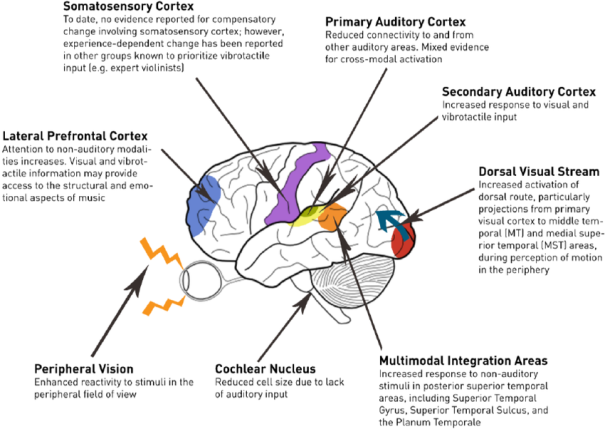
Figure 2. Figure showing the musical suspense on different part of human brain.
1.13. Visual Stimuli, Music and Brain
Visual aids with music produces negative and positive emotions. Cases of fear bringing out film music incorporate Bernard Herrmann's score for Alfred Hitchcock motion pictures, most prominently with Psychology (1960) and 1975’s J William jaw music”
| [6] | Baumgartner, T., Lutz, K., Schmidt, C. F., & Jäncke, L. (2006). The emotional power of music: How music enhances the feeling of affective pictures. Brain Research. |
[6]
(Baumgartner et al., 2006). Cases of positive enthusiastic enhancement possess large amounts of motion picture comedies and in ad. Two researches tapped brain processes when litening music and watching visual aid. Baumgartner and associates (2006) find out how sad of fearful music effect mood. It was found that with visual aids listening to music results in increase brain functioning in several areas
| [6] | Baumgartner, T., Lutz, K., Schmidt, C. F., & Jäncke, L. (2006). The emotional power of music: How music enhances the feeling of affective pictures. Brain Research. |
[6]
(Baumgartner et al., 2006). But still they speculated that music alone can leads to similar brain processes. However, the discoveries of Baumgartner and associates were additionally upheld by a fMRI study.
(Eldar, et al., 2007)
| [17] | Eldar, E., Ganor, O., Admon, R., Bleich, A., & Hendler, T. (2007). Feeling the real world: Limbic response to music depends on related content. |
[17]
Investigator examined how combination of scarry or happy song with impartial clip can differ view of the nonpartisan film. It was shown that light movement music had more prominent effect. Optimistic music along with neutral film, as associated with neutral film alone, enhance activity in the region of amygdala only. Furthermore, it was found the rate of brain processes with them. Still the participants response was consistent with the psychophysics findings
| [17] | Eldar, E., Ganor, O., Admon, R., Bleich, A., & Hendler, T. (2007). Feeling the real world: Limbic response to music depends on related content. |
[17]
(Eldar et al., 2007).
1.14. Dissonance, Fear, and Sadness Due to Unpleasant Music
Many researches have worked on feelings produced by musicAvoiding feelings are produced by music. The sad music instruments are soft dynamics, legato articulation, and slow tempos
| [29] | Juslin, P. N., Liljeström, S., Västfjäll, D., & Lundqvist, L.-O. (2010). How does music evoke emotions? Exploring the underlying mechanisms. In Handbook of Music and Emotion; Theory, Research, Application. Oxford University Press. |
[29]
(Juslin, 2010). Dissonant stimuli produce unpleasant feelings in music. Within the peripheral sensory system occurs the perception of sensory dissonance. Inner ear does not have sufficient spatial resolution. High pitch tone create cause irritation
| [29] | Juslin, P. N., Liljeström, S., Västfjäll, D., & Lundqvist, L.-O. (2010). How does music evoke emotions? Exploring the underlying mechanisms. In Handbook of Music and Emotion; Theory, Research, Application. Oxford University Press. |
[29]
(Juslin et al., 2010). In addition, “firing patterns of auditory nerve impulse had been found to be associated with dissonance”
| [14] | Damasio, A. (2010). Living with Consciousness. In Self comes to mind: Constructing the conscious brain. New York: Pantheon. |
[14]
(Damasio, 2010). Still satisfactory reasons for poor acoustic resolution leading to avoiding tendencies and cortices in the superior temporal gyri is also included
| [18] | Fishman, Y. I., Volkov, I. O., Noh, M. D., Garell, P. C., Bakken, H., Arezzo, J. C, Steinschneider, M. (2001). Consonance and dissonance of musical chords: Neural correlates in auditory cortex of monkeys and humans. Journal of Neurophysiology. |
| [43] | Peretz, I. (2001). Brain specialization for music. New evidence from congenital amusia. Annals of the New York Academy of Sciences. |
[18, 43]
(Fishman, 2001)(Peretz, 2001). Sensory dissonance affective aspects processing, on the extra pointer, as described in upcoming section, mainly involves the para-hippocampal gyrus.
1.15. Anterior Cingulate and Insular Activity Related to Pleasant Music
The quality of music depends on how much it alter or change the arousal and activation
| [14] | Damasio, A. (2010). Living with Consciousness. In Self comes to mind: Constructing the conscious brain. New York: Pantheon. |
[14]
(Damasio, 2010). Pleasurable music listening causes changes in autonomic and endocrine system. In a study 2001, Blood and Zatorre
| [7] | Blood, A. J., & Zatorre, R. J. (2001). Intensely pleasurable responses to music correlate with activity in brain regions implicated in reward and emotion. Proceedings of the National Academy of Sciences of the United States of America. |
[7]
has exposed the power of bodily reactions “(i.e. heart beat, activity of muscles, and respiratory rate)” increased beside with the familiarity of greater than before biting intensity, and happened parallel with a increase flow of blood in cerebrum bilaterally in the insular and anterior cingulate cortices. Studies reveals that classical music listening result in positive emotions. Comparing, the activity of cingulate cortex can be increased related with the listening arousal rated low in level beside of valence, it observed that increased activity in insula when joyful VS sad musical pieces were compared
| [32] | Koelsch, S., Fritz, T., Cramon, D. Y., Müller, K., & Friederici, A. D. (2006). |
[32]
(Koelsch et al., 2006), when pleasant music were compared with others
| [10] | Brown, S., Martinez, M. J., & Parsons, L. M. (2004). Passive music listening spontaneously engages limbic and paralimbic systems. Neuroreport. |
[10]
(Brown et al., 2004). In the end greater activity was discovered by Menon and Levitin to standard musical pieces.
Feelings are processed by anterior cortices
| [13] | Damasio, A. (1999). The feeling of what happens: body and emotion in themaking of consciousness. New York: Harvest Books. |
[13]
(Damasio, 1999) the activity of that region is associated to pleasurable music listening. Of course, the system of subcortical region is also related with the activation of such feelings that is induced by music. This pleasure produced by these regions can also be modified with the release of certain biochemical in the human body areas of brainstem.
1.16. Music and Brain in Theoretical Perspectives
Psychological or Cognitive Perspective:
Many of the studies related to musical linkages comes across in two fields of study: neuroscience and cognition. Psychological approach observed related fact development in music and in the relationship to another
| [48] | Sheehan, P. W. (1967). A shortened form of Betts’ questionnaire upon mental imagery. J. Clin. Psychol. |
| [42] | Pearce, M., & Rohrmeier, M. (2012), Music cognition and the cognitive sciences. Topics in Cognitive Science. |
[48, 42]
(Shore, 2010; Pearce & Rohrmeier, 2012). Strong connection have been revealed related music students’ increases in cognitive aspects in every failed over non-musicians, also can be seen in many studies related to specific test results
| [22] | Helmrich, B. H. (2010). Window of opportunity? Adolescence, music, and algebra. Journal of Adolescent Research. |
| [26] | Johnson, C. M., & Memmott, J. E. (2006). Examination of relationships between participation in school music programs of differing quality and standardized test results. Journal of Research in Music Education. |
| [30] | Kinney, D. (2008). Selected demographic variables, school music participation, and achievement test scores of urban middle school students. Journal of Research in Music Education. |
[22, 26, 30]
(Helmrich, 2010; Johnson & Memmott, 2006; Kinney, 2008). Whereas many researcher may see a direct relation, where music supports, so many related facts prevent a clear statement of causality. One variation of the cognitive theory is the near transfer theory of relating musical skills to brain activation.
Near transfer theories tells the connection between shared cognitive abilities through cognitive point of view of music.
| [55] | wilson, M., Carr, D., Lau, J., & Alvarez, H. (2006). Music for pain relief (Review). Cochrane Database of Systematic Reviews. |
[55]
(Wilson, and Prior (2006) according to wilson near transfer theory can be define as “relative cognitive skills require by spatiotemporal reasoning tasks and Musical instruction. During musical instructions learning that occurs, therefore, can be transfer to other movements or tasks. For example, On the keyboard learning understanding spatial relations and to read musical notation requires visuo-spatial skills”.
1.17. Neuro-scientific Theory
Neuro-scientific models of music interaction is based on a concept of shared usage of the brain. Theories about nerves refer to account to assume special areas of the human brain are used for both spatial and musical task
| [23] | Hetland, L. (2000) Learning to make music enhances spatial reasoning. Journal of Aesthetic Education. |
[23]
(Hetland, 2000). New brain imaging techniques leads to a paradigm shift in the understanding of the brain, specifically concerning multiple regions working with one another. Technological advances question prior understanding of the brain, specifically those related to the hemispheric divide of brain functions
| [41] | Olson, C. A. (2010). Music training causes changes in the brain. Teaching Music. |
| [54] | Weinberger, N. M. (1998). The music in our minds. Educational, Leadership. |
[41, 54]
(Olson, 2010; Weinberger, 1998). Brain imaging shows brain functioning in unison for even simple tasks. The meta-synthesis that follows presents the research evidence that show brain activations in musical and mathematical tasks.
1.18. Experience of Music in the Perspective of the Music and Brain in Neurobiological Framework
1st experiance, music could not be undeniable significance to the survival of humans people or different kind of species. Because music does not nourish us, rescue us from mischief, or battle one contentions. Nonetheless, given belove accompanying realities are settled or well established:
(1) Music incite a wide range of feelings, sentiments from bliss and serenity to pity and fearness
| [50] | Sloboda, J. A., O’Neill, S. A., & Ivaldi, A. (2001). Functions of music in everyday life: An exploratory study using the experience sampling method. Musicae Scientiae. |
[50]
(Ivaldi, 2001, and Sloboda, O'Neill).
(2) “Cognition and behavioral deviations are also related to influential music
| [5] | Bartlett, D. L. (1996). Physiological responses to music and sound stimuli. In Handbook of music psychology. |
[5]
(Bartlett, 1996)”.
Listening music changes the condition of the autonomic sensory system or nerves system filed by, in between others, heart and breathing rates or respiration, savior skin reactions, and temperature of body
| [7] | Blood, A. J., & Zatorre, R. J. (2001). Intensely pleasurable responses to music correlate with activity in brain regions implicated in reward and emotion. Proceedings of the National Academy of Sciences of the United States of America. |
| [46] | Salimpoor, V. N., Benovoy, M., Larcher, K., Dagher, A., & Zatorre, R. J. (2011). Anatomically distinct dopamine release during anticipation and experience of peak emotion to music. Nature Neuroscience. |
| [53] | Trost, W., Ethofer, T., Zentner, M., & Vuilleumier, P. (2012). Mapping aesthetic musical emotions in the brain. Cerebral Cortex. |
[7, 46, 53]
(Blood et al,. 2001; Salimpoor et al,. 2011; Trost et al., 2012). music obviously alter the condition of the human body and in this way correct body structure in the territories of the CNS related with homeostatic control, for example, brain central system or brain system nuclei, the separate cortices
| [10] | Brown, S., Martinez, M. J., & Parsons, L. M. (2004). Passive music listening spontaneously engages limbic and paralimbic systems. Neuroreport. |
| [57] | Zentner, M., Grandjean, D., & Scherer, K. R. (2008). Emotions evoked by the sound of music: Characterization, classification, and measurement. Emotion. |
| [50] | Sloboda, J. A., O’Neill, S. A., & Ivaldi, A. (2001). Functions of music in everyday life: An exploratory study using the experience sampling method. Musicae Scientiae. |
[10, 57, 50]
(Brown et al., 2004; Sloboda, O'Neill, and Ivaldi, 2001), and the cingulate cortices
| [7] | Blood, A. J., & Zatorre, R. J. (2001). Intensely pleasurable responses to music correlate with activity in brain regions implicated in reward and emotion. Proceedings of the National Academy of Sciences of the United States of America. |
[7]
(Blood et al,. 2001; Menon et al,. 2005). Generally our sentiments identified with music listening rise up out of this useful chain, and such music activated emotions can help us to singular prosperity
| [53] | Trost, W., Ethofer, T., Zentner, M., & Vuilleumier, P. (2012). Mapping aesthetic musical emotions in the brain. Cerebral Cortex. |
[53]
(Trost et al., 2012) and, not remarkably, to an extensive variety of useful social encounters
| [12] | Chanda, M. L., & Levitin, D. J. (2013). The neurochemistry of music. Trends in Cognitive Sciences. |
| [16] | DeNora, T. (2000). Music in everyday life. Cambridge University Press. |
| [31] | Koelsch, S. (2010). Towards a neural basis of music-evoked emotions. Trends in Cognitive Sciences. |
[12, 16, 31]
(Chanda and Levitin, 2013; DeNora, 2000; Koelsch, 2010).
For some music pieces and for some audience members, music-actuated feelings determine frame the direct emotional capability of musical rythem and basic structure, but for other musical clip and audience members, sentiments get from layers of intervened psychological advances
| [11] | Cepeda, M., Carr, D., Lau, J., & Alvarez, H. (2006). Music for pain relief (Review). Cochrane Database of Systematic Reviews. |
[11]
(Cepeda et al., 2006), for example, memory, inspirations, preparing of reviewed substance, and investigation of melodic structure (plot).). It is to be noted, After all, these intervened psychological advances have, in of themselves, the ability to produces feelings. The expression, "tasteful feelings" could apply to that more unpredictable spicier process in spite of the fact that we considered the center understanding of this emotions and consequent sentiments to conferm the general plan of process of emotions and resulting development of emotions as examined before.
Prior people groups commentators that music can't instigate essential "ordinary" feelings identified with the survival, and that music-produces feelings ought to be ordered independently, as "tasteful," and differentiated to "utilitarian" feelings
| [57] | Zentner, M., Grandjean, D., & Scherer, K. R. (2008). Emotions evoked by the sound of music: Characterization, classification, and measurement. Emotion. |
[57]
(Zentner et al., 2008). Nonetheless, the related thought that audience members may have the capacity to see the passionate articulation of music without essentially feeling that enthusiastic experience has been under verbal communication
| [28] | Juslin, P. N., & Sloboda, J. (Eds.). (2010). Handbook of music and emotion: Theory, research, applications. Oxford University Press. |
[28]
(Juslin and Sloboda, 2010). Let us see this example, it has been expect that since audience members are typically securely expelled from dangers, risks, and the likelihood of misfortunes, negative feelings, including apprehension, sadness, or outrage would be seen as expressive properties of music rather than really getting to be felt reactions to music
| [57] | Zentner, M., Grandjean, D., & Scherer, K. R. (2008). Emotions evoked by the sound of music: Characterization, classification, and measurement. Emotion. |
[57]
(Zentner et al., 2008). After all, even, "aesthetic" feelings can't be viewed as altogether incorporeal. It can likewise evoke physiological changes. It has been assume that music can connect with natural physiological activity phenomenons and, by doing as such assist reestablish the cognitive state to a range of relative homeostatical adjustment.. Changes in human body expresses that outcome from this activity progress can be seen in both the upper part of brainstem and in the cerebral cortex (i.e., separate and cingulate cortices) that can be observed in general induce emotions both of sorrow, enjoyble/satisfaction, plus dread/horror
| [33] | Koelsch, S., Skouras, S., Fritz, T., Herrera, P., Bonhage, C., Küssner, M. B., & Jacobs, A. M. (2013). Neural correlates of music-evoked fear and joy: The roles of auditory cortex and superficial amygdala. Neuroimage. |
| [50] | Sloboda, J. A., O’Neill, S. A., & Ivaldi, A. (2001). Functions of music in everyday life: An exploratory study using the experience sampling method. Musicae Scientiae. |
[33, 50]
(Koelsch et al., 2013) (Sloboda, O'Neill, and Ivaldi, 2001). It is main problem which deserve facilitate test examining to be definitively settled
| [9] | Brattico, E., Alluri, V., Bogert, B., Jacobsen, T., Vartiainen, N., Nieminen, S., & Tervaniemi, M. (2011). A functional MRI study of happy and sad emotions in music with and without lyrics. Frontiers in Psychology. |
[9]
(Brattico et al., 2011).
Normal individual chooses to invest a lot of time, energy listening music
| [16] | DeNora, T. (2000). Music in everyday life. Cambridge University Press. |
| [49] | Skånland, M. S. (2013). Everyday music listening and affect regulation: The role of MP3 players. International Journal of Qualitative Studies on Health and Well-Being. |
[16, 49]
(DeNora, 2000; Skånland, 2013). A reports from diverse examinations have also indicate that audience members from various parts of the world can relate emotions or to new songs from other societies customs
| [1] | Balkwill, L., & Thompson, W. F. (1999). A cross-cultural investigation of the perception of emotion in Music: Psychophysical and cultural cues. Music Perception. |
| [2] | Balkwill, L., Thompson, W. F., & Matsunaga, R. (2004). Recognition of emotion in Japanese, Western, and Hindustani music by Japanese listeners. Japanese Psychological Research. |
| [19] | Fritz, T., Jentschke, S., Gosselin, N., Sammler, D., Peretz, I., Turner, R, Koelsch, S. (2009). Universal recognition of three basic emotions in music. Current Biology. |
[1, 2, 19]
(Balkwill and Thompson, 1999; Balkwill, et al, 2004; Fritz et al., 2009)”. Showing impression all-inclusiveness of musical emotions. They absolutely demonstrate that music of fluctuated sorts can producess "emotive" responses and resulting feelings that may turn out to be exclusively and socially noteworthy recommending that a homeostatic impact is likely. Such an impact isn't limited to grown-ups as there is proof of full of feeling responses to music by newborn children as young as two months
| [52] | Trainor, L. J., Tsang, C. D., & Cheung, V. H. W. (2002). Preference for sensory consonance in 2- and 4-month-old infants. Music Perception. |
[52]
(Trainor, et al, 2002). May be as anyone might expect, music has a for all intents and purposes part and critical influence in various flag get-togethers, for example, religious functions, weddings, and in a verity of different festivals.
The contention that music could be assume as a part in life is the reality, also assuming from the investigations of animal vocalizations, that a large number animals and birds shows their shortcoming or weaknesses and sadness by conveying high or rising note sound, while quality, hostility, and regional predominance are conveyed utilizing sounds with low or falling note
| [39] | Morton, E. S. (1977). On the occurrence and significance of motivation structural rules in some bird and mammal sounds. The American Naturalist. |
| [24] | Hinton, L., Nichols, J., & Ohala, J. J. (1994). The frequency code underlies the sound-symbolism use of voice-pitch. In Sound symbolism. Cambridge University Press. |
[39, 24]
(Morton, 1977, Hinton et al., 1994). The close association amongst emotion and society-related behavior and controls of specific pitch, a focal component of music and sound-production, is inevitable. Could be, the course of musical development in music infers a "full of feeling emotions" in connection to recurrence. Considering historical point of view, it is possible that the utilization of contribute low and high sound could have started as a psychological way for passing on a specific emotional state in any case, as numerous musical dimension including song, amicability, sound, and music advanced and turned out to be more mind complex, the "implications" of sounds turned out to be less firmly identified with homeostatic esteem. Considered al the situation, the autonomic sensory system enactment that we feel when we hear very much made music might be connected to a limited extent to the variety of acoustic recurrence or frequency introduced in the music. Together, the upper actualities propose, that a noteworthy explanation behind music's all inclusive interest may emerge from the enthusiastic/inclination impacts that music creates in writers
| [57] | Zentner, M., Grandjean, D., & Scherer, K. R. (2008). Emotions evoked by the sound of music: Characterization, classification, and measurement. Emotion. |
[57]
(Zentner et al., 2008), players, and audience members, alongside the social outcomes of these impacts.
Basically we perceived that the actualities examined given are good with the theory that the feelings and emotions initiated by music could be associated with the key procedure of life processing and homeostasis. It has been mentioned earlier that early people found that specific pitch of sound and certain blends of music produces unsurprising feelings and emotions. For instance, the voice of human while singing, beating, and the weaseling of a flute may have been used for enchantment and for mental comfort next misfortune and malady
| [14] | Damasio, A. (2010). Living with Consciousness. In Self comes to mind: Constructing the conscious brain. New York: Pantheon. |
[14]
(Damasio, 2010). Music have also encouraged social capacities or functioning, for example, gather association and general correspondence
| [31] | Koelsch, S. (2010). Towards a neural basis of music-evoked emotions. Trends in Cognitive Sciences. |
[31]
(Koelsch, 2010) and cultivated engagement in expectant interchange of hope and reward
| [21] | Gebauer, L., Kringelbach, M. L., & Vuust, P. (2012). Ever-changing cycles of musical Pleasure: The role of dopamine and anticipation. Psychomusicology: Music, Mind and Brain. |
[21]
(Gebauer, et al, 2012). Quickly, music may have won in mankind's history to a great extent in light of its commitment to prosperity and relatedly to survival. The plausibility is completely perfect with the mentally and socially independent status of expand assortments of music creation and listening.
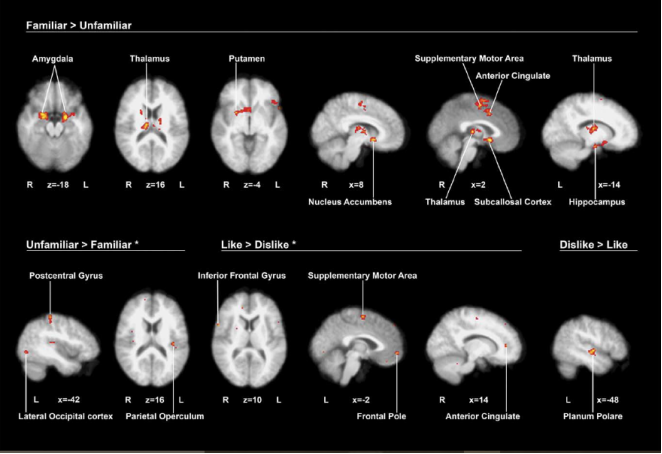
Figure 3. fMRI results. Statistical maps superimposed on standard brain in the MNI space. Images were thresholded using clusters determined by Z.2.5 and a corrected cluster significance threshold of P = 0.05. When marked with asterisk, images were threshold at P = 0.005 uncorrected. Coordinates are presented in mm. L = left hemisphere; R = right hemisphere. doi: 10.1371/journal.pone.0027241.g003.
Pop/shake tunes and songs were used in this research that individuals tune in to in regular day to day existence to examine how melodic inclinations and commonality regulate the movement of cerebrum locales enrolled amid music tuning in and perciving. I found that music tuning had just a peripheral effect on the activation of brain, paralimbic and remunerate systematic zones and areas. Despite what might be expected, commonality expanded blood oxygen level reliance (BOLD) initiated by music, reaction in that emotion related areas, to be specific in the putamen, amygdala, core accumbens, front cingulate cortex and thalamus.
Reactions to melody (enthusiastic) have already been appeared to enlist limbic, paralimbic and remunerate organizations of the mind. Be that as it may, it was not clear how factors, for example, commonality and melodic inclinations interface in regulating movement in these mind areas. In my investigation, I found that most feeling related mind action was activated by commonplace (preferred or hated) music as opposed to enjoyed (well-known or new) music, as per according support our assumption about the essential part of the nature eefect in music thankfulness and enlistment of feelings in the cerebrum.
| [7] | Blood, A. J., & Zatorre, R. J. (2001). Intensely pleasurable responses to music correlate with activity in brain regions implicated in reward and emotion. Proceedings of the National Academy of Sciences of the United States of America. |
[7]
(Blood and Zatorre, 2001) have announced a relationship between's expanded power of felt chills when tuning in to most loved bits of music and actuations or deactivations of such area, to be specific the core area in the ventral striatum, amygdala midbrain, ventral medial prefrontal cortex and orbitofrontal cortex.
However it is not stress, the bits of sound rythm utilized would be exceedingly natural to the members, They Are permitted to pick the ones that reliably deliver extreme joy and chills. As a result, Brown and his colleagues (2004)
| [10] | Brown, S., Martinez, M. J., & Parsons, L. M. (2004). Passive music listening spontaneously engages limbic and paralimbic systems. Neuroreport. |
[10]
utilized new unfamiliar pleasurable sound, depicted enactments in the upper front cingulate cortex, hippocampus, whole brain and furthermore the core accumbency. This is significant, however, initiation these are observed in the core accumbency is sub threshold. I found it in my investigation, rather, no neuronal movement in the upper striatum was acquired because of loved music, even subsequent to utilizing a more liberal factual limit without revision. One conceivable explanation behind the error with the outcomes got amongst Browns' and my investigation is that, despite the fact that the correct time of the boost term in their examination isn't determined, it was most likely significantly more than the thirty seconds I utilized. Additionally, they had just two useful outputs, everyone with an alternate melody (most likely the whole tune), enabling the subjects to have more opportunity to get emotionally drew in with the new tune.. It might then be guessed that a more drawn out presentation to new (and enjoyed) music in my examination would have created more grounded reactions in the limbic framework as well. In the vast majority of studies, be that as it may, it was discovered that melodic passages of 1 sec just were sufficient to permit the acknowledgment of essential feelings of satisfaction and misery in the members
| [50] | Sloboda, J. A., O’Neill, S. A., & Ivaldi, A. (2001). Functions of music in everyday life: An exploratory study using the experience sampling method. Musicae Scientiae. |
[50]
(Sloboda et al,. 2001)., and that this impact is pitifully affected by melodic aptitude and extract term. Likewise each other analysis demonstrated that the time that subject required to begin a passionate judgment is very longer for new than for well-known sound, which can show that additionally the enthusiastic association (i.e. the sentiment feelings, that is unique in relation to the recognizable proof of feelings) can be regulated by commonality. Be that as it may, the time term of enthusiastic reactions amid music tuning is not explore in neuroimaging research, and in this manner ought to be the concentration of future examinations and study.
The two investigations tending to the pleasurable emotions got from music that I examined so as have utilized (positron emission tomography), and it is conceivable that the above system does not have the determination to precisely find little structures like the core accumbency. A later report utilized fMRI and utilitarian and viable availability to demonstrate that hearing sound have a solid impact in mesolimbical skeleton of the reinforcement circuitry like the core accumbency and the ventral tegmental region, yet additionally in the hypothalamus and the insula. Other extremely new paper plainly demonstrates the arrival of dopamine in the mesolimbic remunerate framework in connection with serious pleasurable encounters inspired by music. Significantly additionally, it demonstrates that, in reckoning of these pinnacle enthusiastic reactions, the caudate core was more dynamic, while amid the experience of the pinnacles themselves, expanded action I found in the right correct core accumbency. It happens that, in this investigation, the researcher used music that was very commonplace to the members, yet did not tastefully control for the commonality of the nonpartisan melodic jolts, leaving open the likelihood that this factor may have added to the portrayed enactments. In addition, just 8 out of around 200 subjects demonstrated a predictable pinnacle enthusiastic reaction to music and were hence chosen for the examination, synthesizing it hard to sum up these outcomes to the general population. In our examination, Brown (2004)
| [10] | Brown, S., Martinez, M. J., & Parsons, L. M. (2004). Passive music listening spontaneously engages limbic and paralimbic systems. Neuroreport. |
[10]
also discovered expanded bold reaction in the right core accumbency, inquisitively with the nearby maxima in an indistinguishable directions from in
| [46] | Salimpoor, V. N., Benovoy, M., Larcher, K., Dagher, A., & Zatorre, R. J. (2011). Anatomically distinct dopamine release during anticipation and experience of peak emotion to music. Nature Neuroscience. |
[46]
(Salimpoor et al., 2011) be that as it may, just for recognizable music. This implies, in previous studied where nature is not legitimately controlled, the enactments of this mind activity may had been wrongly ascribed to the sole sentiment loving, disposing of a part of recognition.
I additionally got, with recognizable tunes, solid two-sided activation in the amygdala and the subcallosal cingulate cortex. The two areas has been beforehand corresponded to the emotion reactions to music boosts. Amygdala actuations were concerned with hateful sound, offensive music and both pleasant and new music. The subcallosal part of the whole cingulate cortex have also been appeared to be dynamic, with charming/sad music.
Likewise the putamen demonstrated two-sided expanded movement in good musical condition, that could be represented the nerves synchronization with the mood of pop/shake extracts; a similar capacity can also be observe to the active saw in the thalamus (for an audit, see. Like our outcomes, Brown and associates additionally demonstrated the enlistment of the putamen, along accentuation of the right area, as will as the subjects is looking dancer moving to a general, metric cadence. Obviously, individuals can synchronize to dancer and move to new music too, however perhaps the activation of the basal ganglia may demonstrate that recognition with the melodic jolt is a conspicuous effect that connecting with the audience members additionally systematically, other than psychologically.
Another bunch of initiation for commonplace over new music that is setuated in the SMA. My translation of this initiations is that the members may have quietly music the familier song. This steady in the proposition by Halpern and Zatorre and Halpern that this specific regions is active amid mintal emotions, or the demonstration of imaging music in our psyches, others that is probably going to be occur while you see a tune and can anticipate whatever coming next.
A few behavioral investigations affirmed what has been already demonstrate by Meyer, which the constructive outcome of earlier presentation on music is preferring, likewise called the minor introduction impact. These outcomes were additionally repeated in my listening trial, somewhere we watched that inside the gathering of songs that close-fitted the stylish inclinations of every member, the ones that were well-known was the best exceedingly appraised as far as enjoying (
Figure 3). As needs be, the mind comes about demonstrated that recognizable tunes, as well as those that were loved and those that were despised, were effective in triggering the system of mind locales known to react to emotional stimuli.
Another analysis revealed an impact like the minor presentation impact, this time likewise also taking in observation distortion (upbeat and pitiful) of the melodic jolts and the nature of the listening strategy (engaged or accidental). They
| [7] | Blood, A. J., & Zatorre, R. J. (2001). Intensely pleasurable responses to music correlate with activity in brain regions implicated in reward and emotion. Proceedings of the National Academy of Sciences of the United States of America. |
[7]
(Blood and Zatorre, 2001) found that the impacts of introduction on loving are diverse for engaged and accidental listuner, to be specific that enjoying evaluations were higher for cheerful melodies, yet just in the engaged listening condition. They additionally watched that loving appraisals expanded directly as a result of presentation, yet just in the coincidental hearing situation. In the engaged hearing situation, enjoying evaluations were spoken to by a transformed U in capacity of presentation, implying that the rehashed introduction at first builds the appraisals of the tunes, yet it at that point turned to produce an ''over-recognition'' impact, give responce in the diminishing of the appraisals. These investigations recommend that the unimportant redundancy of tunes is adequate to expand the full of feeling reactions to these songs, in any event in an underlying stage.
As far as we are concerned, we give the principal practical neuroanatomical proof for a solid impact of commonality in the way audience members' get emotional drowning in the music, in any event inside an exploratory setting. Our outcomes not just reinforce the assemblage of confirmation demonstrating that music is exceptionally proficient in enlisting passionate focuses of the brain, yet in addition clearly give prove that nature a specific bit of music is a critical factor for emotional envolment, and subsequently clarify ''coordinate access'' for this kind emotional focuses of the human brain.





 Share This Article
 Twitter
 Linked In
 Facebook
 Copy
Copy Download